The gamechanger and the regime: Péter Magyar’s ambivalent frontier position as political resource
Updated: May 8
By Szilvia Horváth, Postdoctoral Researcher at the University of Helsinki

On April 12, in a landslide victory, the Tisza Party led by Péter Magyar defeated the illiberal Orbán regime, which had been in power for 16 years. Images of young people celebrating the victory with unbounded joy, just like Magyar himself, made headlines around the world. For the second time since 1990, Hungarians have changed their political system, now after a long, nearly two-decade-long authoritarian detour.
In doing so, they set an example that authoritarian, right-wing populism - which is, incidentally, also organized internationally - can be defeated, and indeed through a massive, popular alliance. The movement’s leader, Péter Magyar, played a decisive role in this change.
Magyar is not only a political actor who catalyzes processes, but also the movement’s symbol. Researchers, witnessing the movement’s emergence in Hungary and analyzing the “Magyar phenomenon,” argue that he is a charismatic leader onto whom people projected various attributes, and whom they accepted as possessing a special legitimacy. This is why the fabricated accusations the regime used to delegitimize him simply rolled off him.
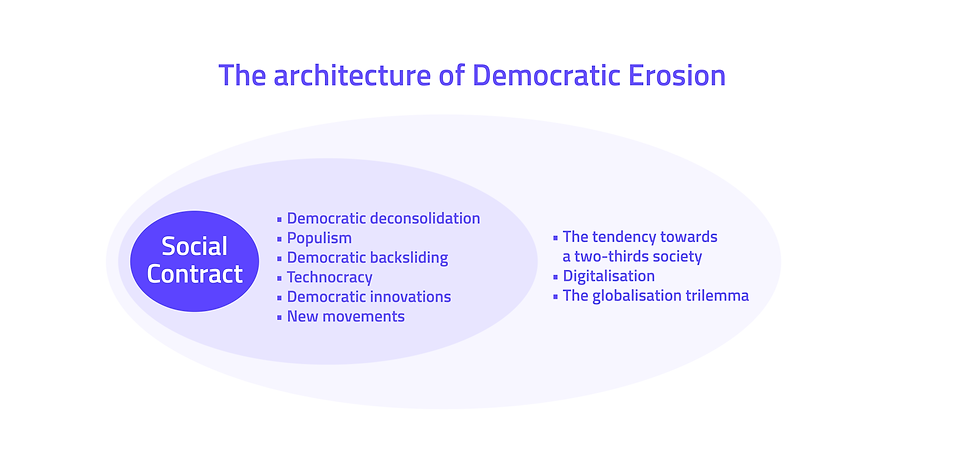
Our discourse-theoretical research focused on political discourse in the broad sense, with a particular emphasis on the opposition’s challenge to Orbán’s social contract. The preliminary research findings show that, just like Tisza’s political discourse, Péter Magyar occupied a frontier, transitional position. In terms of discourse, he drew elements from both existing political spaces. In his self-construction as a politician, he bridged insider status and radical opposition. That is, he comprised the distinctive dynamics of the inside and the outside, which served as resources and catalysts for political processes.
When discrediting reinforces credibility
Prior to his political turn, Péter Magyar was part of the regime’s elite networks; his ex-wife was a former minister. After leaving Fidesz, he founded a broad popular movement. He managed to span the gap between the elite and the people by developing a counter-discourse that draws a frontier between the corrupt Orbán regime and the morally pure Hungarians who “deserve better.” The politician belongs to the latter category, in a moral communion with a complex people.
After breaking with Fidesz, the government’s counterpropaganda applied two rhetorical figures to him: “traitor” and “footballer’s wife”. These reinforced that he was an insider, while suggesting that he was appointed to state business positions because he was married to a minister.
It is particularly important to note that, through these rhetorical maneuvers, the regime legitimized its own corruption and confirmed the widespread belief that it was based on nepotism. Paradoxically, Magyar’s insider status, combined with defection, helped validate his moral standing. The regime’s propaganda was unable to transfer the moral corruption characteristic onto him. The ambiguous status he held, that is, coming from within the regime but no longer part of it, supported the construction of his own authenticity as a new actor, even as he was able to challenge the regime’s legitimacy.
On the other hand, the label the regime applied to him as a “traitor,” reinforced the perception that the regime is both a closed, exclusionary system propelled by strong feelings of resentment and operating on a principle of revenge. Perhaps most importantly, it also demonstrated that cracks can appear in this closed system, and people began to leave it.
Becoming a politician and constructing authenticity
The fact that Péter Magyar initially did not want to take on a political role also lent authenticity. The moral process of becoming a politician took place before a large audience. This process contributed to the construction of a charismatic appeal that attracted many supporters, but it must also have been especially attractive to hesitant former Fidesz supporters, with their not-yet-articulated grievances. As my fieldwork in the countryside showed right before the election, even a former Fidesz supporter could have turned into a Tisza activist standing in front of a campaign booth on a town’s main square. Magyar’s rites de passage, from Saulus to Paulus, could provide a relatable point towards the leader, as well as a moral justification for those who left the regime.
From mobilization to overcoming polarization
The paradox that someone can be a radical challenger to the regime precisely because they come from within it may have also helped shape Péter Magyar’s image as a credible political actor in another sense. The fact that he came from Fidesz ensured he was not left-wing. This is a major advantage in a right-wing political culture. In essence, the “Fidesz seal”, that is, a right-wing guarantee, signaled distance from the political left.
Both the discourse of the Tisza movement and, as we have seen, Péter Magyar’s self-construction on the frontier and this position’s ambivalences were, in fact, political resources. These constructions broke the long-standing hegemonic logic of polarization in Hungary, a cornerstone of Fidesz’s claim to power.
Nonetheless, one frontier was drawn in an extremely radical manner: the one against the regime. By the time of the elections, “Tisza” had become completely synonymous with “change” and “regime change.” Standing on the ambivalent frontier is not only a resource for legitimacy and mobilization, but also an opportunity to resolve three decades of polarization and to foster reconciliation. On election night, Péter Magyar defined this, among other things, as a key task for the whole community: “healing the wounds”.