Is Democracy Eroding? Nine Fields of change in contemporary democracies
By Prof. Claudia Wiesner, Dr Jessica Schmidt and Dr. Muriel C. Wenzel.
Democracy is widely described as being in crisis. Elections still take place, constitutions remain formally intact, and democratic language is ubiquitous, yet trust is declining, participation is uneven, and political conflict feels harder to resolve.
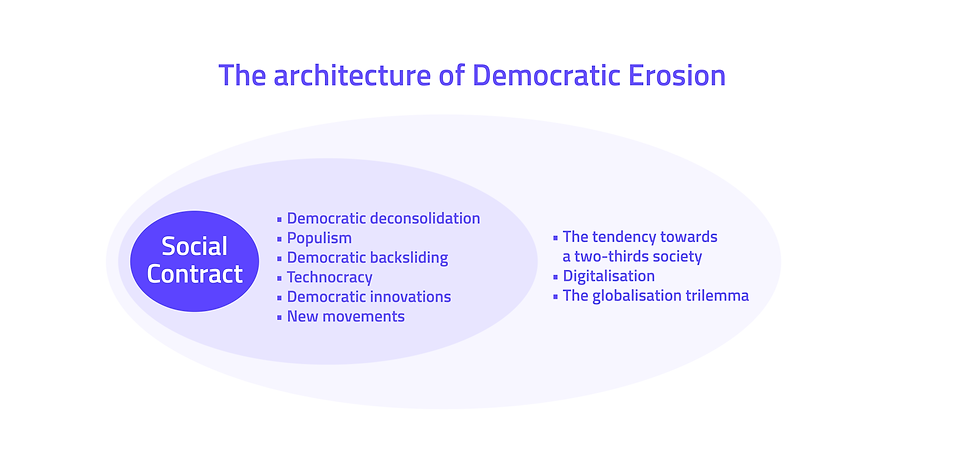
What is far less clear, however, is why democracy appears to be in crisis – or whether it is just changing. The literature does not offer a single answer. Instead, it presents several competing explanations, each highlighting different mechanisms and blind spots. Those explanations can be grouped in nine fields of change that emerge out of the current state of art of the debate.
Six of the fields describe changes to democracy, the social contract and the way they work and manifest as such. Those six fields are: democratic deconsolidation, populism, democratic backsliding, technocracy, democratic innovations, and new movements. Three other fields describe decisive changes of the societal context of democracy and the social contract, these are: the tendency towards a two-thirds society, digitalisation, and the globalisation trilemma. The following will look at four of these fields in more detail.
Under the label of democratic deconsolidation, democratic erosion is approached from the bottom up. According to this view, democracy weakens because citizens are losing faith in it as “the only game in town.” Declining trust in institutions, falling voter turnout, and growing political disengagement suggest a gradual withdrawal of democratic consent. Importantly, this is not a story of collapse or authoritarian takeover. It is a slow process in which people stop seeing democratic procedures as meaningful ways to shape decisions that affect their lives.
Over time, this erosion of legitimacy can make anti-pluralist politics, or “strong leader” solutions, appear more acceptable—not because citizens reject democracy outright, but because democracy no longer feels uniquely legitimate. Many scholars stress that dissatisfaction often targets how democracy performs—its responsiveness, fairness, and integrity—rather than the democratic ideal itself. This makes erosion of democracy difficult to detect until participation and compliance begin to decline. Moreover, the picture of decline is not a simple one – besides a decline in classical participation channels, Europe has seen a number of new movements in the last years.
Some European responses to such an “erosion from within” focus on institutional safeguarding. Others try to strengthen the everyday, participatory foundations that make democratic capture less viable in the first place. Democratic innovations are the catchword here. For example, the New European Bauhaus explicitly links Europe’s transformation agenda to living spaces and lived experience, calling on
Europeans to “imagine and build” sustainable and inclusive futures together—treating participation and shared ownership as part of what sustains democratic legitimacy. In a different register, the Council of Europe’s New Democratic Pact for Europe frames democratic repair as rebuilding trust by making democracy tangible in daily life “through participation, accountability and equal access to rights,” echoing the idea that institutions ultimately depend on societal buy-in.
Democratic backsliding (or autocratisation), is the third field of change where the focus is on political elites and institutions. In this perspective, democracy erodes because it is hollowed out from within the institutional system, i.e. from the top-down. Research on populism and democratic backsliding shows how elected governments weaken courts, constrain media, politicise oversight bodies, and erode checks and balances—often while claiming democratic mandates. Elections continue, legality is formally maintained, and democratic language is preserved, even as the substance of pluralism and accountability is steadily undermined.
What makes this form of erosion distinctive is that it operates through (formerly) democratic procedures rather than against them, often hollowing out these very procedures. Critics of the backsliding approach, however, caution against overly simplistic elite-driven narratives. The literature shows that democratic backsliding often depends on citizen permissiveness or support, not just elite intent. Elites may push institutional boundaries, but publics may tolerate or even endorse norm violations if they prioritise policy outcomes or identity-based appeals over democratic rules.
Another field of change refers to technocracy. This approach focuses less on actors and more on how democracy is governed, and by whom. From this perspective, democracy erodes because it has become increasingly technocratic. Decision-making shifts toward unelected expert bodies, regulatory agencies, and crisis management mechanisms – these are sometimes formally legitimate but socially distant, in other cases even their legitimacy is doubtful. When political choices are framed as technical necessities rather than contested values, democratic agency weakens.
In this account, democracy does not collapse; it becomes thinner. Citizens may continue to vote, but feel that elections change little. Participation becomes symbolic, while key decisions are insulated from public debate. Over time, this depoliticisation can fuel frustration, disengagement, and resentment—creating fertile ground for both populist mobilisation and democratic withdrawal.
Importantly, also the social context of democracy and social contracts changes and inequality increases. The literature on the “two-thirds society” and social cohesion, moves beyond institutions and governance to society itself. Democracy erodes, this view argues, because societies are fragmenting.
Rising inequality, exclusion, and the emergence of a society split between secure insiders and marginalised outsiders undermine shared democratic experience. While institutions may function well for some, others find themselves structurally excluded from political, economic, and social participation.
Here, democratic erosion is not primarily procedural but material, and experiential. The horizontal dimension of democracy—relations among citizens based on mutual recognition, trust, and a sense of political equality—weakens over time. As everyday experiences of democracy diverge, the social foundations that sustain democratic legitimacy erode quietly.
The erosion of social cohesion is aggravated by digitalisation, i.e. the increasing role of digital tools and social media. While digitalisation on one hand increases possibilities for participation, it also enables the construction of social bubbles and echo chambers in which different social or political peer groups communicate among themselves, rather than being part of a broader public space that encompasses citizens from a variety of political camps and identities.
Taken together, these nine fields of change suggest that democratic erosion is not driven by a single cause. It unfolds across multiple dimensions at once—institutional, societal, and experiential. Understanding this complexity does not make democratic repair easier. The approaches also underline that democratic decline is not a simple, and maybe not even a clearcut diagnosis –in some cases we merely observe changes. But the above does make one thing clear: if democracy is eroding quietly, it cannot be restored by focusing on only one explanation, or one solution, alone.
These fields describe the way democracy and its social context changes. They focus on what happens within democratic systems. By contrast, the European Democracy Shield approaches democratic erosion from a markedly different angle. Rather than focusing on how democracy erodes or changes from within through weakened legitimacy, participation, or everyday experience, it frames democracy primarily as something under threat from an outside—through foreign interference, disinformation, and hybrid attacks on electoral processes.
This protective logic responds to real and pressing risks, but it rests on a different diagnosis: that democracy’s core institutions remain fundamentally sound, and that the main task is to shield them from external manipulation. As such, it complements—but does not substitute for—initiatives that seek to address the internal, social, and experiential conditions through which democracy can quietly hollow out even when formal protections remain in place.


